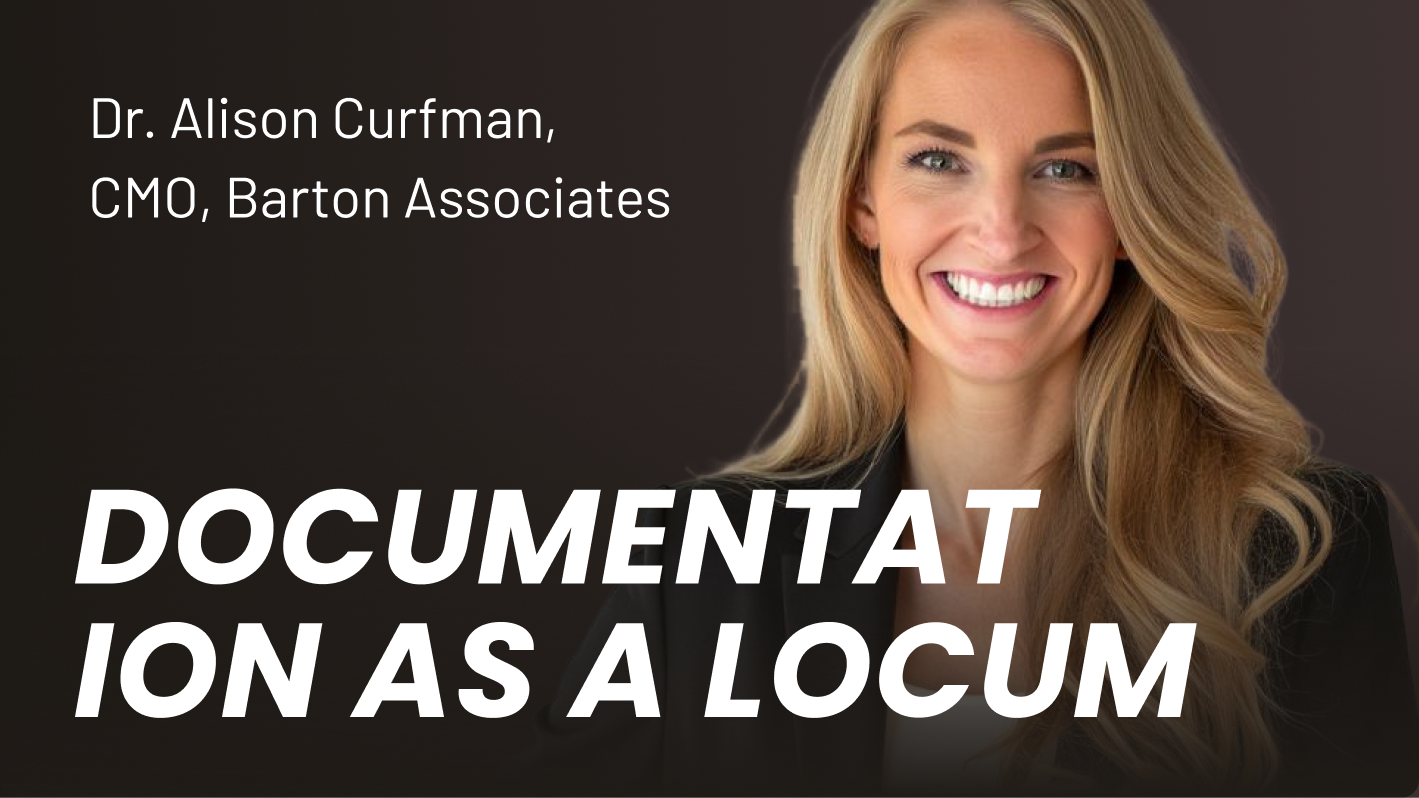
Documentation
Best Practices for
Locum Tenens Clinicians

Documentation is where a lot of otherwise excellent locum clinicians lose ground — not in the clinical work, but in the written record. The standard for locums documentation is higher than for permanent positions, for a straightforward reason: you won’t be around to clarify it.
A permanent clinician who writes an ambiguous note can be asked about it in the hallway the next day. A locum clinician can’t. By the time billing or audit lands, you’re weeks past the assignment and three sites further along. The note has to stand alone.
Documentation deficiencies account for approximately 30% of physician billing audit findings, according to the HHS Office of Inspector General. Notes that lack specificity get downcoded, denied, or flagged — and the liability lands on the clinician of record.
Who Reads Your Notes
- The next clinician caring for that patient at the site — reading your note to understand what happened and what to do next
- Billing and coding — assembling claims from the clinical record, not from your memory
- Compliance and quality teams — auditing charts against quality measures and regulatory standards
- Legal — a malpractice question two years after the assignment references your note as the contemporaneous record
Ask on arrival who that person is. The introduction takes two minutes.

The Five Elements of a Complete Note
Regardless of setting, a complete note includes:

The reason for the encounter
stated plainly. Not "follow-up" but "follow-up at three weeks for new-onset hypertension started on lisinopril 10 mg.

The clinical findings
what you observed, in language another clinician could replicate.

The clinical reasoning
two or three sentences explaining why you arrived at the assessment you did. Not a textbook, but enough that another clinician can follow your thinking.

The plan
medications, procedures, follow-up, referrals, patient education. Specific.

Decision rationale on close calls
when you made a judgment call (admitting vs. discharging, observing vs. intervening), the rationale belongs in the note. A judgment call that lives only in your memory is invisible to every downstream reader.
Smart Phrases That Travel
Each EMR has its own smart-phrase and macro system. The phrases you build in one EMR don’t transfer to the next. A locum clinician who depends on EMR-specific shortcuts loses efficiency at every transition.
The working solution: maintain your own library of pre-written common phrases as plain text — in a notes app, a secure-notes field in your password manager, or a simple document you carry between assignments. Paste into whichever EMR you’re using and adapt to the case.
High-value phrase categories:
- Normal-exam templates for common chief complaints
- Decision-rationale starters for common judgment calls (discharge vs. observation, conservative vs. intervention)
- Patient instructions for common discharge or follow-up scenarios
- Procedure notes for procedures you perform across settings
The library lives with you, not with the EMR. Building it is one-time work.
Sign Every Chart Before Leaving
A permanent clinician who leaves a chart unsigned can finish it the next day. You can’t rely on that pattern. Charts unsigned at the end of a shift sit in the queue until you return to the EMR — which may be weeks later, or after you’ve left the assignment entirely.
Sign every chart before leaving the building, every day. The exceptions are charts genuinely incomplete because outstanding results haven’t returned — note those as pending and revisit at the next access point.
Clinicians who complete documentation daily finish assignments cleanly. Clinicians who batch documentation create backlogs that rarely get worked once the assignment ends.

The Post-Assignment EMR Check
Dr. Alison Curfman describes her own discipline for the weeks after an assignment:
“I set aside time to go into the EMR a few weeks after an assignment to make sure nothing has been sent back from billing. Sometimes it's hard to keep up with compliance training at multiple sites, so I set reminders. I also make sure that whoever is my main contact at the site or agency knows how to reach me if there's a compliance notification I didn't receive.”

Three practices in that approach:
- Scheduled post-assignment EMR check — a few weeks after the assignment ends, log back in to clear billing kickbacks or note-completion requests. Usually short. The unaddressed item compounds.
- Compliance-training reminders — annual modules at multiple facilities create a calendar problem you own. Personal reminders on a defined cadence solve it.
- Contact-information discipline — the agency and site have a current phone number and email that reaches you after the assignment ends.