11 October, 2023
In May 2021, the AAPA, a national organization that advocates for PAs, voted to change the title of the PA profession from “physician assistant” to “physician associate.” According to the AAPA, this change was made to better reflect the work PAs do, as their scope of practice is much broader than merely “assisting” doctors.
But has this title change made headway among working PAs? In preparation for National PA Week (October 6–12), we asked our network of locum tenens PAs to answer a short questionnaire about whether they call themselves a “physician assistant” or “physician associate” and why.
Ultimately, 267 PAs responded and gave us their insight—and the results might surprise you. Read on to learn more.
According to our survey of the locum tenens PAs in Barton Associates’ network, which was open from September 29 to October 5, 2023, PAs are mostly split on whether they use “physician assistant” or “physician associate” to describe their title.
In fact, 49% of respondents (130 PAs) said they prefer using “physician assistant,” while 51% (137 PAs) said they prefer using “physician associate.” The graph below shows the percentage distribution for this question.

Do younger PAs have a preference when it comes to referring to themselves as an “assistant” or “associate”? What about those who are middle-aged or older?
Our survey found that PAs across all age groups are mostly split on what they prefer to use. The below chart illustrates the number of people within each age group who answered for “assistant” or “associate.”
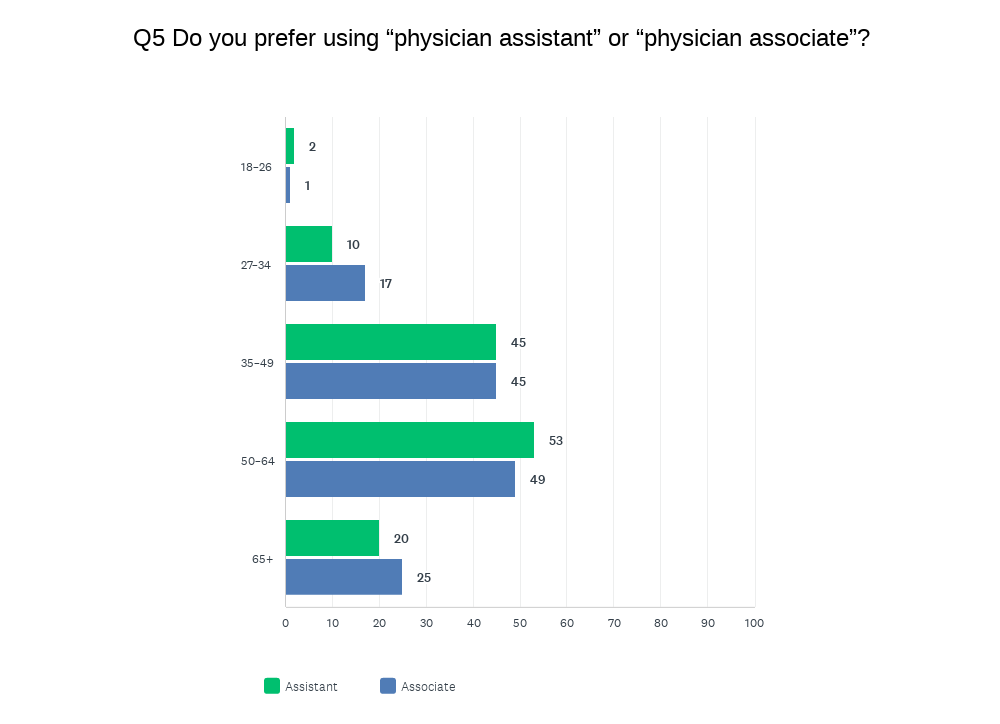
With these results in mind, it’s easy to see that the division between “physician assistant” and “physician associate” translates to age groups.
Although Barton Associates is a locum tenens recruiting and staffing agency, our PA network consists of full-time locums, part-time locums, and providers in permanent positions.
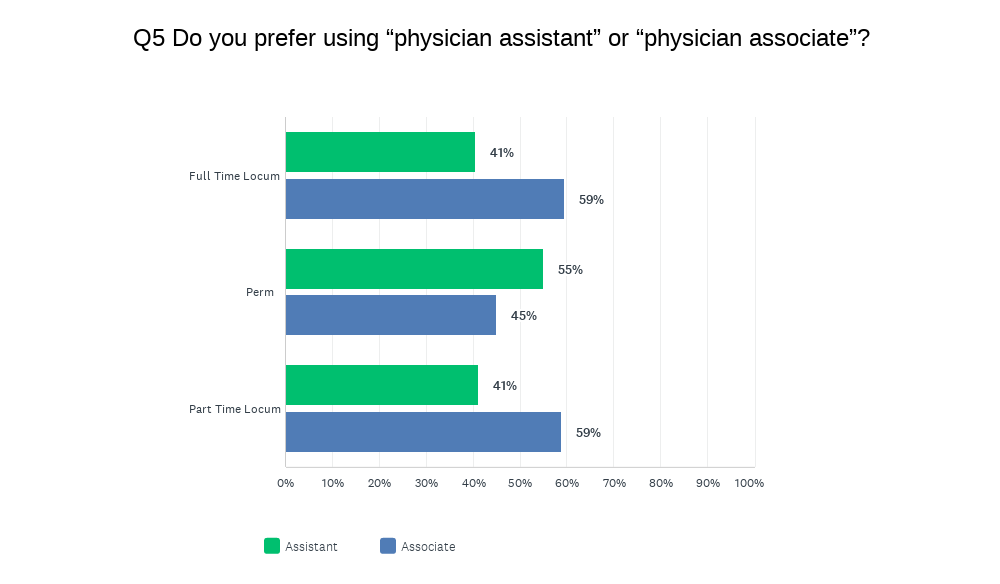
Our survey found that full-time and part-time locum PAs are more likely to refer to themselves as “physician associates,” with 59% of those professionals preferring that title. The results flip for permanent providers, as 55% of those medical professionals prefer “assistant.”
The graph below shows the differences between all three of these employment groups:
While the data our survey uncovered tells a story on its own, we wanted to hear from our PAs directly about why they prefer using “physician assistant” or “physician associate.” Here’s a word cloud illustrating some of the most common terms used in this response section:

Those who prefer using “physician assistant” primarily said they choose to use that title because it’s what has been used historically. Here are some direct quotes from PAs who said they prefer using “physician assistant:”
Those who prefer “physician associate” had a variety of reasons for their decision, such as that it more accurately describes their role and leads to less confusion for patients who may think they’re just assisting doctors. Here are some direct quotes from PAs who said they prefer using “physician associate”:
In conclusion, it’s clear that PAs have generally not come to a consensus on the AAPA’s title change. Regardless of what they’re called, these medical professionals are essential to the continued success of our country’s healthcare system.
Barton surveyed 267 active PAs through SurveyMonkey from September 29 to October 5, 2023. These PAs are in Barton’s vast database of providers and includes full-time locums, part-time locums, and professionals in permanent positions aged 18 to 65+.
Are you a PA or other medical provider looking for locum tenens work? Do you manage a healthcare facility and need staffing help? Barton Associates is a locum tenens staffing and recruiting agency that will work with you to find the job or staffing solution you need. Check out our job board, or reach out to us today to get started.


On June 19, 1865, Union soldiers arrived in Galveston, Texas, and read aloud General Order No. 3: all enslaved people were free. The Emancipation Proclamation […]
Read Time : 4 min
 by
April Hansen 18 June, 2026
by
April Hansen 18 June, 2026 When a small, remote town loses one of the only primary care physicians, the impact doesn’t stay inside the clinic walls. Families start driving two […]
Read Time : 6 min
 by
Amanda Orta 28 May, 2026
by
Amanda Orta 28 May, 2026 Peabody, Mass. and Salt Lake City, Utah, May 6, 2026 — Barton Associates, Inc., a leading locum tenens staffing and workforce solutions organization, today announced […]
Read Time : 2 min
 by
Barton Team 6 May, 2026
by
Barton Team 6 May, 2026 In more than 80 percent of U.S. counties, access to essential healthcare services is limited. According to research from GoodRx, more than 120 million Americans, […]
Read Time : 6 min
by
Barton Team 16 March, 2026